

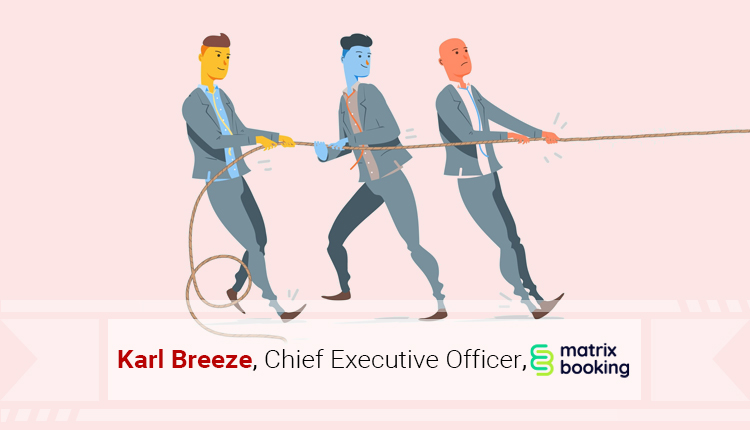
Discussions about the future of work often focus on the relationship between leadership and employees. Yet, an equally important debate is playing out within the C-suite itself.
CEOs, CFOs and HR leaders each bring a different vision of what the workplace should become. While all are focused on long-term business success, their priorities often pull in opposing directions, shaped by their unique responsibilities and outlooks.
These differences create a delicate balancing act for leadership teams. Beyond managing office space logistics, they must also weigh the long-term impact on employee retention, brand reputation, and financial performance.
With external pressures mounting, alignment at the top has never been more crucial. A failure to establish common ground risks leaving organizations stuck in a reactive loop, struggling to meet both operational demands and workforce expectations.
Read More on Hrtech : HRTech Interview with Vidhya Srinivasan, Chief Product and Marketing Officer at Magnit
Competing priorities in the C-suite
CEOs, CFOs, and HR each approach workplace strategy with different objectives, shaping their perspectives on what the future office should look like. CEOs often view the office as a core hub for collaboration and brand identity, a space that can drive productivity and nurture innovation. Many worry that without an office, company culture will suffer, even though others have shown it is possible to thrive without making the office central to their strategy.
Perhaps the deeper concern lies in the fear of stepping into uncharted territory. For many CEOs, running a company without a traditional office represents a significant departure from their professional experience. At the same time, they are being warned that in-person collaboration, whether through team meetings, social interactions, or strategy sessions, is invaluable for spurring innovation and alignment within teams.
CFOs remain focused on cost-efficiency and maximizing return on investment, often questioning whether maintaining large office spaces is financially justifiable in today’s climate. For CFOs, the financial sustainability of office decisions is tied directly to the organization’s ability to remain competitive. This makes them advocate for space reduction or hybrid models that aim to balance cost-saving measures with operational needs.
HR leaders, meanwhile, prioritize employee wellbeing, satisfaction, and talent retention. They recognize that flexible work environments must cater to diverse employee needs, adapting to a workforce that increasingly values options and inclusivity over rigid, one-size-fits-all policies. HR’s challenge is to champion these priorities while ensuring alignment with broader organizational goals. For HR, creating a workplace strategy that supports engagement and productivity while addressing diverse expectations is critical for long-term success.
Finding common ground
The differing priorities of CEOs, CFOs and HR inevitably lead to disagreements over the future of office space and working models. Some argue for downsizing or hybrid approaches, while others advocate for maintaining existing spaces. These debates can create tension within leadership teams which can ripple through to the broader business strategy and decision-making process.
Navigating these disagreements demands a proactive approach that balances operational needs with employee expectations. By tapping into data-driven insights, leaders can uncover patterns in office usage that would otherwise go unnoticed. For instance, tracking peak occupancy times might highlight opportunities for staggered schedules, reducing overcrowding and improving efficiency.
Real-time occupancy sensors can provide visibility into how spaces are being used throughout the day, allowing adjustments that improve efficiency and the employee experience. Predictive analytics can also forecast future needs, helping organizations redesign layouts or allocate resources strategically. These tools not only reduce friction between stakeholders but also enable informed, forward-looking decisions that align with both business goals and workforce needs.
A unified approach to workplace strategy
Long-term success depends on leadership teams bridging the gaps in their workplace strategies. Economic pressures, talent competition, and evolving employee expectations make it increasingly important for CEOs, CFOs, and HR leaders to align their priorities. Data-driven insights can be instrumental in this process, offering a clearer picture of how space is used and helping organizations make proactive, considered choices rather than reactive ones.
Recent examples highlight what happens when workplace strategies aren’t built on data. Amazon’s return-to-office (RTO) policy ran into significant roadblocks due to insufficient space, causing delays and straining employee trust[1]. Similarly, JP Morgan encountered logistical challenges following its return-to-office mandate, with desk shortages in its London headquarters creating frustration among employees and sparking criticism of the policy[2].
Ultimately, the future of the workplace isn’t about choosing one model over another. It’s about finding a solution that works for everyone. By recognizing that productivity, culture, and flexibility can coexist, organizations can move beyond internal power struggles and create a workplace strategy that supports long-term growth, employee engagement, and business success.
Catch more HRTech Insights: HRTech Interview with Pearce Dolan, Head of Product at Deel
[To share your insights with us, please write to psen@itechseries.com ]